Letterwright is an untimed word-grid game for iPhone and iPad. Swap neighbouring letters to make words of four to eight letters, read left to right or top to bottom. Clears change the board, and longer words earn moves back. Your job is to make each swap useful before your moves run out.
This guide is written by KilkaLabs, the game’s developer. It explains the current rules and uses actual Letterwright screenshots. You can also check the App Store description for current compatibility and purchase information.
Start with a board language and a mode
The game offers English, German, and Russian word dictionaries. Choose the board language you want to play; the words you look for should belong to that dictionary.
Then choose between two ways to play:
- Classic: Start a run with 20 moves and try to keep it going by making words and earning moves back.
- Daily: Play one free puzzle per board language each day. Players receive the same board for that language and day.
There is no timer. Spend a moment reading the starting grid before you make your first swap. Move management, not speed, is the constraint you need to watch.
Swap neighbouring tiles
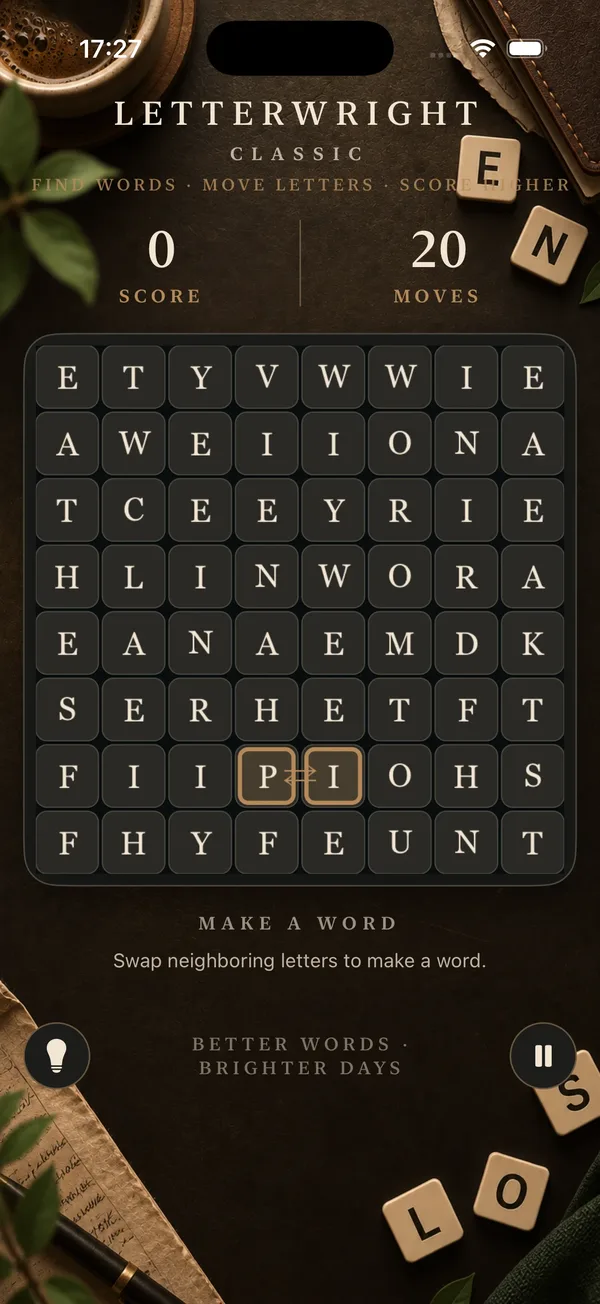
A move trades the positions of two neighbouring letter tiles. Look for a nearly complete word in a row or column, then see whether one nearby letter can complete it.
Do not treat the board as a bag of letters you can freely rearrange. The neighbouring-tile rule means a useful letter elsewhere in the grid may take more than one move to bring into place. That distance matters when your remaining moves are low.
Form words in the reading direction
Words are four to eight letters long. They read left to right across a row or top to bottom down a column. This is not a game of tracing a diagonal or winding path through the grid.
For a simple illustration, imagine a row contains S E T A. Swapping the neighbouring T and A would arrange S E A T, a four-letter English word. This is a teaching example, not a claim that those exact tiles appear in every starting board.
When checking a possible word, read the whole sequence in the correct direction. A familiar collection of letters is not enough if they are out of order or if the word belongs to a different board language.
Let clears and cascades change the board
Making a word clears tiles and shifts the grid. That can create another word, leading to a cascade. The result is part of the appeal: one small change can affect more of the board than the letters you first noticed.
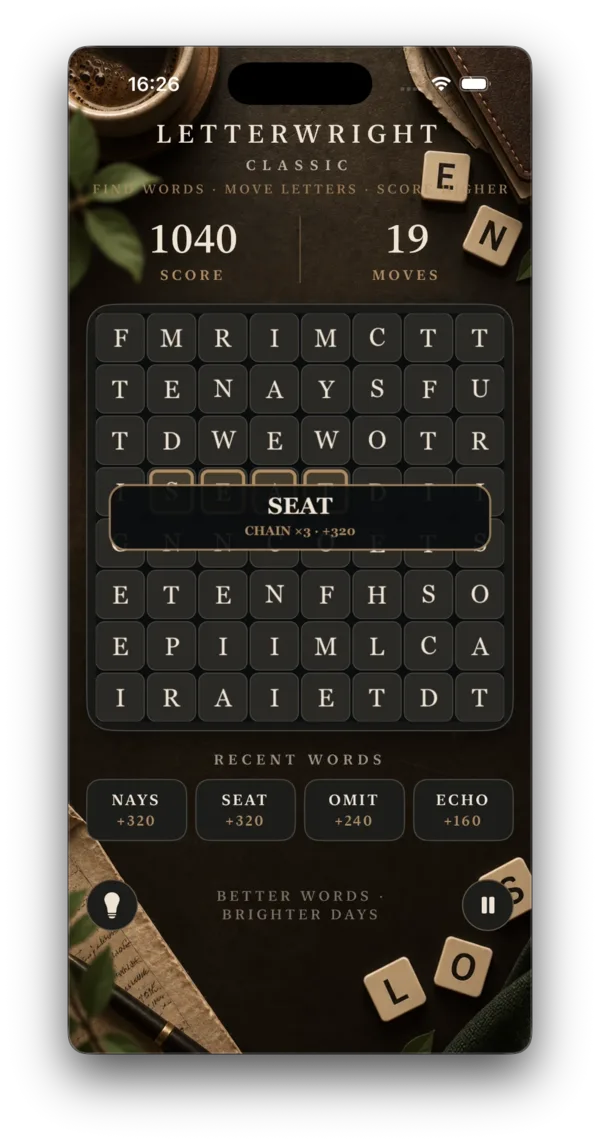
After the board settles, scan it again rather than automatically continuing your previous plan. Tiles may have moved, and a word you were preparing may no longer be available. Equally, the new position may give you a simpler next move.
Watch the remaining moves
Longer words earn moves back. This makes word length important, but it does not mean every plan for a long word is efficient. Count the swaps you would spend getting there.
A nearby four-letter clear can be useful when it changes an awkward board. A longer word can be useful when you can build it without spending too many setup moves. You are balancing the immediate opportunity with the ability to continue.
For your first runs, keep it simple: look for a word one swap away, make it, and pause to inspect the result. Our Letterwright strategy guide develops that habit into a repeatable approach.
What is free, and what does Full Game unlock?
Your first five completed Classic runs are free. A one-time Full Game purchase unlocks unlimited Classic play permanently; it is not a subscription. Daily provides one free puzzle per board language each day.
There are no ads and no required account. The game works offline. If you already bought Full Game, use Restore Purchases in Letterwright to restore an existing purchase; support can help with questions, and Apple handles billing and refunds.
If you arrived from another tile-swapping game, read Letterwright vs W.E.L.D.E.R. for the similarities and the differences rather than assuming the rules carry over unchanged.
Put your next word in motion.
Play Letterwright on iPhone or iPad. No timer, no ads, no account. Your first five completed Classic runs are free; unlimited Classic play is a one-time purchase.
Get Letterwright on the App Store