The most useful Letterwright habit is simple: before you swap, name the word you are trying to make and count the moves it will take to arrange it. That will not solve every board, but it gives each move a purpose.
Letterwright starts a Classic run with 20 moves. Longer words earn moves back, while clears and cascades change the grid. These developer-written tips follow those rules; they are practical suggestions, not a mathematically optimal solver or a promise of a particular score. If you are new, read the basic rules first.
Scan the board before moving a tile
There is no timer, so use the pause the game gives you. Read rows from left to right and columns from top to bottom. Look for words of four to eight letters that are almost in the right order.
A useful first scan has three questions:
- Is there a word I can finish with one neighbouring swap?
- Is there a longer candidate nearby that costs only a little more to arrange?
- Would clearing either one disturb letters I want for the other?
Do not move a tile just because two letters look better together. A promising pair is only useful if it contributes to a complete word or a specific next step.
Count setup swaps, not just letters
A long word is attractive because longer words earn moves back. But reaching it can still spend a lot of your remaining budget. Compare the whole plan, not just the word at its end.
For example, imagine you see a four-letter word one swap away and a six-letter candidate several swaps away. The six-letter word is not automatically the better choice. Check whether you can actually move the required letters into place without disrupting the candidate, and whether you can afford the setup.
This is deliberately not a fixed scoring formula. The guide does not assume a particular move reward for every length or predict the letters that will arrive after a clear. Use the remaining-moves display to judge what your current run can support.
Keep more than one possible next word
Try not to commit your entire attention to a single distant word. If the board changes during setup, a second candidate can give you a way forward without continuing a plan that no longer fits.
Common letter groups can help you spot candidates, but do not treat them as words by themselves. In an English board, an ending such as “-ing” is a clue to investigate; it does not make the surrounding letters a valid word. The complete sequence still needs to belong to the chosen dictionary and fit the length rules.
Likewise, a strategy based on English patterns is not automatically useful in German or Russian. Choose a board language you are comfortable reading, and scan for words in that language rather than trying to reuse the same combinations everywhere.
Reassess after every clear
A clear is a new position, not just a reward. Tiles shift, a cascade may occur, and a word you were preparing can disappear or change. Wait for the result before deciding on the next swap.
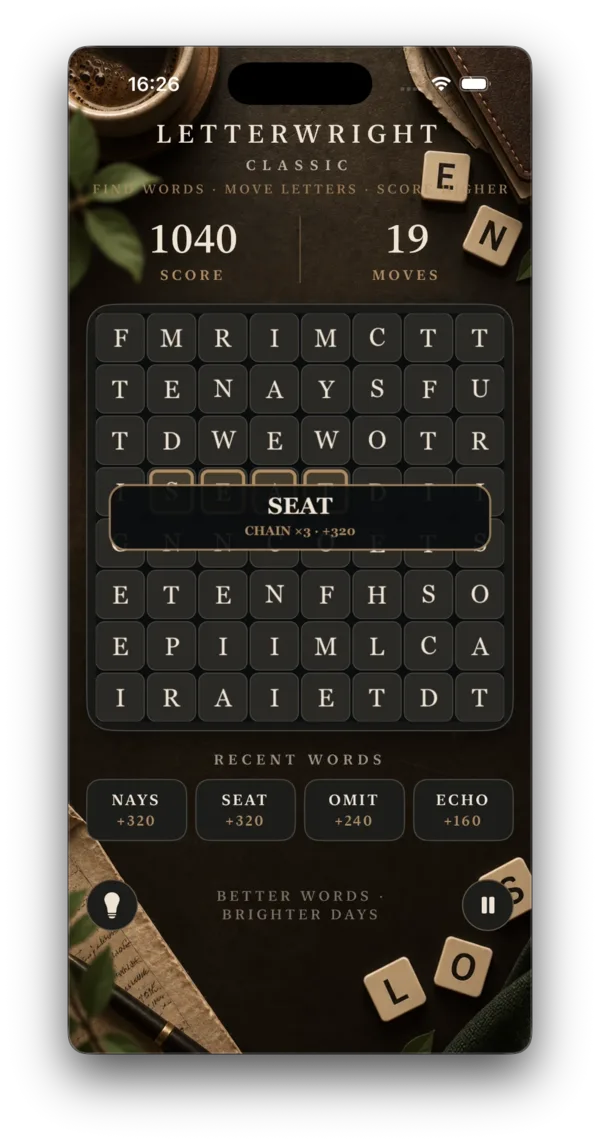
You can look at what sits above a possible clear to consider how the board might change. Treat that as planning, not certainty: future letters and cascades are not something this guide promises you can predict exactly. A plan that works without a lucky follow-up is easier to evaluate than one that depends on it.
Simplify when moves are running low
With a small budget, speculative rearrangement becomes harder to justify. Return to the nearest complete word rather than spending your last moves on a candidate that needs several steps.
That does not mean the shortest word is always best. It means the shortest affordable route to a useful clear deserves attention. If a longer word is also one swap away, evaluate it. If it requires moves you do not have, it is not a current option.
A helpful check is: “If nothing fortunate happens after this swap, do I still know what I am doing next?” When the answer is no, scan the rest of the board before committing.
Use Daily as a focused practice session
Daily offers one free puzzle per board language each day, with the same board for everyone playing that language. It gives you a contained occasion to practise a habit: take a full first scan, count setup moves, or pause after every clear.
You do not need to turn it into a speed challenge. Letterwright is untimed. The point is to make the decision more deliberate, not to make it faster.
For your next Classic run, use one short routine: scan, choose a word, count the setup, swap, reassess. Learn from the result without assuming one successful cascade will repeat on a different board.
Put your next word in motion.
Play Letterwright on iPhone or iPad. No timer, no ads, no account. Your first five completed Classic runs are free; unlimited Classic play is a one-time purchase.
Get Letterwright on the App Store